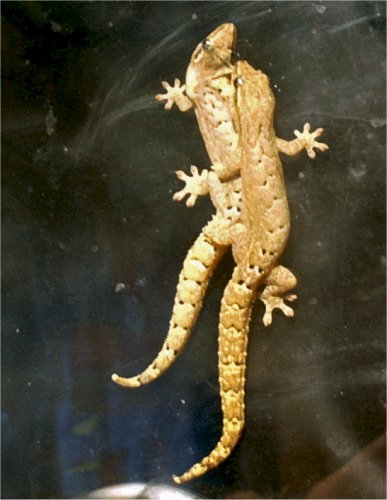
It is not unheard of for parthenogenetic animals to mock breed. In fact there are whiptails in Mexico that are parthenogenetic and within their population there are females that will behave like males that court and mock copulate with the other females, only rubbing the cloaca together, stimulating the females to ovulate. This is the first time I've seen this occur with lepidodactylus lugubris. Great pic and thanks for sharing.(If you feel my post is incorrect please correct me).
obeligz
Jun 17, 2002 4:12 PM
Yes. I have heard about mock breeding within this species.
I'm not sure that this is the case though, I don't know at this point.
Although males in this species are very uncommon they do exist (I think).
I have a dish of crushed eggshells in the bottom of this tank and most of the geckoes eat form the eggshells regularly. Note the large large calcum sacs underneath the head of the bottom gecko. The gecko on top doesn't have them.
I have to investigate the supposed "male" further but I haven't been able to catch "him" yet. I keep about 10 geckoes in one large tank and many of them look very similar. If I can positively ID him I can investigate further and maybe take him to the vet to get a DNA reading if that is possible with a gecko of this size.
Thanks for the comment. :o)
I really apperciate it.
Check out the lepidodactylus homepage I found the other day:
http://home.t-online.de/home/0648491061-0001/en/home_en.html
It's the best homepage about this species that I have found
Regards
obeligz
tokaybyt
Jul 25, 2002 2:05 AM
Just in reference to the Cnemidophorus. There are a few species/subspecies here in the US that are unisexual as well. For examle: Cnemidophorus dixoni, Cnemidophorus exsanguis, C. flagellicaudus, C. laredoensis, C. neomexicanus, C. sonorae, C. tesselatus (some males have been found, but parthenogenesis has been observed), C. uniparens, and C. velox. Some of the animals may have been reclassified. I can't find my Stebbins guide at the moment and the Amphibians and Reptiles of New Mexico book is loned out to someone. Those are the only "recent" publications I have on Cnemidophorus.