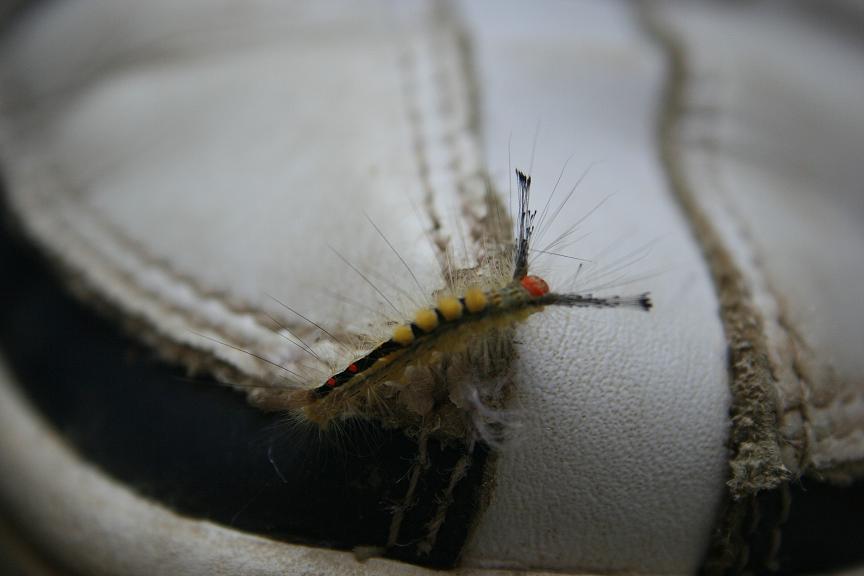
Whitemarked Tussock Moth
by madmunki
Jul 20, 2006 11:38 PM · 2130 views · 51.6 k · 864 x 576
Whitemarked Tussock Moth
Hemerocampa leucostigma (J. E. Smith)
Insects and Diseases of Trees in the South. 1989. USDA Forest Service - Forest Health Protection. R8-PR16. 98 pp. Taken from http://fhpr8.srs.fs.fed.us/forstpst.html
Importance - In the South, the whitemarked tussock moth occasionally occurs in epidemic numbers and heavily defoliates several species of hardwood, primarily live oak, water oak, red oak, and white oak. It is not considered a serious forest pest; however, it causes considerable damage to shade and ornamental trees. Trees are seldom killed, but growth loss does occur. Larvae often create a nuisance in urban and recreation areas due to dropping frass, their allergenic hairs, and their migratory habits.
Identifying the Insect - The larva is 1 to 1 1/2 inches (25 to 38 mm) long. It has a bright red head with a yellowish body, a pair of upright pencil tufts of black hairs on the prothorax, and four white to yellowish brushlike tufts of hairs on the back toward the head. The adult male moth is gray brown, with darker wavy bands and a white spot. The female is wingless and whitish gray.
Identifying the Injury - Young larvae chew small holes in leaves. Older larvae feed on leaf edges, consuming entire leaves, except for larger veins and midribs. Entire trees may be defoliated.
Adult
Photo by James Solomon, USDA Forest Service
Larva
Photo by John H. Ghent, USDA Forest Service
Biology - Overwintering occurs in the egg stage. Eggs are laid in small, white masses and hatch in the early spring. Larvae feed until they pupate in May or June. Pupation occurs in a cocoon, and adults emerge in about 2 weeks. Adults live 2 to 4 weeks. In the South there may be as many as three generations per year. The female adult emerges from a beige cocoon and mates, laying her eggs in a mass on her cocoon.
Control - Parasites, predators, microbial diseases, starvation, and unfavorable weather normally bring epidemics under control. Control is not necessary under forest conditions. In urban and recreation areas, insecticides may be desirable to avoid defoliation, the nuisance effect of this pest, and the allergenic effect of the larval hairs.