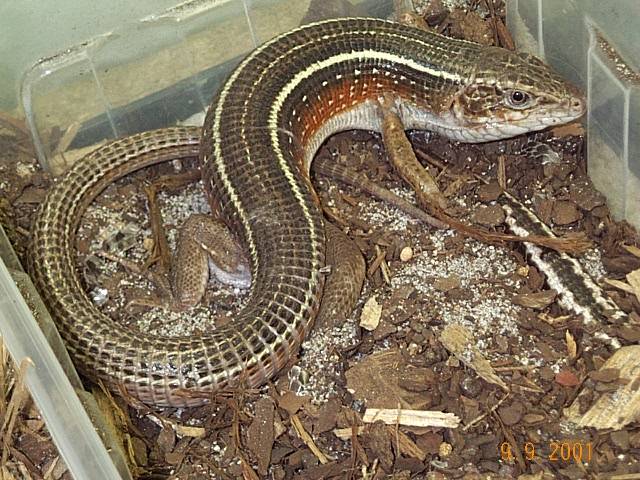
I recently purchased a pair of these lizards.In the pet shop I bought them from they were named giant african plated lizards.Gerrhosaurus validus,can someone verify which is correct.The picture is right on of what i have.THX
jimsakrtrgtr
Mar 4, 2002 6:10 PM
Mike....I have to admit that they look a lot like G. vit but aren't. These Plated Lizards whether from Africa or Madagascar leaves lots to be desired in the way of positive identification. Do you have a digicam so you can send me some pics? Are you a member of the Yahoo Plated Lizard group. Lots of smart people there. But is definitely not a Giaant Plated. Theres still some possibility that it mite be a Z. karsoni. One person thinks for sure its a G. nigrolineatus. So we are still going on the Z. mad for now. Sorry this isn't more helpful. Join our yahoo group and email me when you get a chance. Thnx JIm
jimsakrtrgtr
Mar 8, 2002 6:12 PM
Mike....all bets are off. The mystery critter is definitely a Gerrhosaurus nigrolineatus.
Pauly
Aug 13, 2002 1:25 PM
Rating: 4/5
Actually, G. validus frequently has stripes running down the sides of the back, especially in juveniles, and frequently has a striped side pattern as well. But, this is a G. nigrolineatus, as said.
An African Plated Lizard is A large lizard with a flattened head and body. Length is maximum of 69 cm (27 inches).
The dorsal scales are small with many ridges which give the back edges a serrated appearance. Lower eyelid is covered with small scales.
There are black rubber-like balls on the soles of the feet. The back is dark brown to black, with each head shield and dorsal scale spotted yellow, giving a speckled appearance; a pair of broad dorsolateral stripes is sometimes present.
The throat is dirty white, and the belly is light brown. In breeding season, the chin, throat and sides of the head of the males become tinged with pink-purple.
Her diet consists of: a mixed diet composed largely of leaves, flowers, and fruit; it also captures insects, spiders, millipedes, scorpions, and smaller lizards.
Her Geographical range and Habitat are: Weathered and rocky knolls in South Africa, Zambia, Zimbabwe and Mozambique, with one subspecies in Namibia and southern Angola.